
Measuring slip resistance of a flooring system on dry and wet; the Polysoft choice and results

Date:

May 5, 2026

Posted by:

PolySoft Admin

Blog overview text

Lorem ipsum dolor sit amet consectetur adipiscing elit. Quisque faucibus ex sapien vitae pellentesque sem placerat. In id cursus mi pretium tellus duis convallis. Tempus leo eu aenean sed diam urna tempor. Pulvinar vivamus fringilla lacus nec metus bibendum egestas. Iaculis massa nisl malesuada lacinia integer nunc posuere. Ut hendrerit semper vel class aptent taciti sociosqu. Ad litora torquent per conubia nostra inceptos himenaeos.

Lorem ipsum dolor sit amet consectetur adipiscing elit. Quisque faucibus ex sapien vitae pellentesque sem placerat. In id cursus mi pretium tellus duis convallis. Tempus leo eu aenean sed diam urna tempor. Pulvinar vivamus fringilla lacus nec metus bibendum egestas. Iaculis massa nisl malesuada lacinia integer nunc posuere. Ut hendrerit semper vel class aptent taciti sociosqu. Ad litora torquent per conubia nostra inceptos himenaeos.

Lorem ipsum dolor sit amet consectetur adipiscing elit. Quisque faucibus ex sapien vitae pellentesque sem placerat. In id cursus mi pretium tellus duis convallis. Tempus leo eu aenean sed diam urna tempor. Pulvinar vivamus fringilla lacus nec metus bibendum egestas. Iaculis massa nisl malesuada lacinia integer nunc posuere. Ut hendrerit semper vel class aptent taciti sociosqu. Ad litora torquent per conubia nostra inceptos himenaeos.

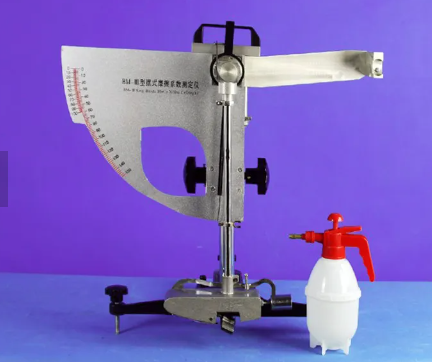
British pendulum slip resistance tester with water spray bottle used for wet flooring tests
The pendulum friction tester — the standard instrument for wet and dry slip resistance testing in over 50 countries.

There are different standards in the world for the measurement and classification of the slip resistance of wet and dry flooring:

  • DIN51130:2004-6 (Germany)
  • DIN51097 (Germany)
  • BS7188:1998+A2:2009 Article 5 (UK)
  • EN13036-4:2011 (Europe)
  • AS/NZS 4586:2013/Amdt-1 2017 (Australia / New Zealand)
  • ASTM E303-22 (USA)
  • ANSI (NSFI) B101.3-2012 (USA)
  • JT/T763 (Japan)

The problem is that each of them define their own test method and measuring device instead of referring to a single test method. These variations in test methods, instruments used and classifications in different countries make it very difficult to evaluate products between countries and lead to confusion and misinterpretation of classifications. To further complicate it, some standards only serve to measure certain types of flooring products, or only in dry conditions, or there are even additional industry standards for different specific applications such as swimming pools, sports fields, pedestrian tiles, etc., and not all of them are referring to a common test procedure, device or classification method.

Basically, two types of instruments are used in these standards:


  • Friction pendulum (also known as British pendulum)
  • Ramp and tribometric measuring instruments
  • Mixed procedures (comparing results to reference calibration surfaces).


So, for each of these standards, various variants of the devices, test procedures, number of samples, kind of values obtained and classifications between the different standards are given.

The pendulum DCOF tester is now a national standard for measuring pedestrian floor slip resistance in at least 50 nations on five continents. It helps architects and designers see how slip resistance will be affected on a particular flooring and to avoid installing one that will become a problem after some heavy use or improper cleaning methods.


In Europe the most common standard for flooring slip resistance was for years the German DIN 51130:2004-6, but more recently the harmonized European standard EN13036-4:2011 has been applied to unify the tests between the different countries of Europe. This is easier for users and the results are better understood than other standards. It is defined by the test method using a friction pendulum that evaluates the properties of a surface in dry and wet conditions, determining its level of slipperiness. The pendulum test method is very reliable. It is measured by a sliding shoe mounted on one end of a pendulum arm that mimics the action of slipping and determines the dynamic friction of the surface. The results are measured with a scale based on a “Pendulum Test Value” PTV – (Pendulum Test Values) or BPN – (British Pendulum Number).


The Australian recommendations, published in 1999 and expanded in 2014, are the world’s most detailed and sophisticated safety criteria for pedestrian wet slip resistance. They have now been used by cruise ship companies, major worldwide corporations, and endless other companies around the world. This Standard provides means of classifying pedestrian surface materials according to their frictional characteristics when determined in accordance with the different test methods set out in Appendices A, B, C, D and E. The test methods enable characteristics of surface materials to be determined in either wet or dry conditions. They use a mix of pendulum and ramp systems as the best fit for each kind of surfacing.


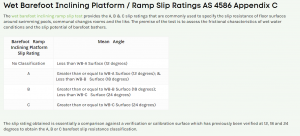
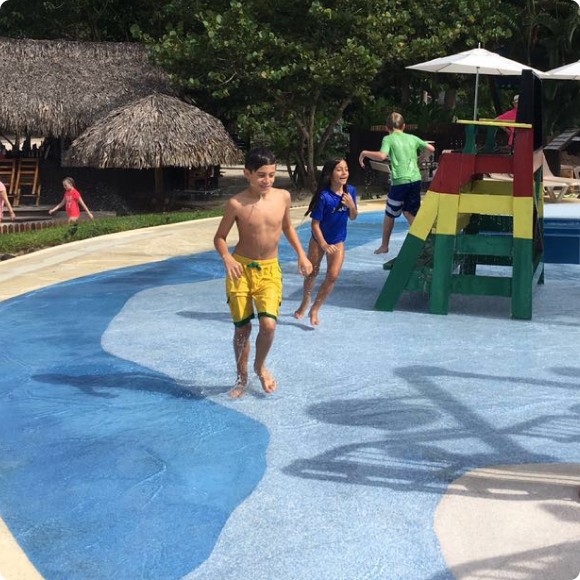
Polysoft has tested their systems with different standards and methods from ramp test and digital tribometers to near all different procedures of Australian Standard including wet pendulum( Appendix A) and oil wet ramp (Appendix D),  but the most interesting one for the way users walk on water sites is the Wet barefoot ramp (Appendix C) and this is the one that Polysoft has been lately using the most for testing their flooring systems.

The wet barefoot ramp test is technically equivalent to DIN 51097. The actual classification is dependent on the angles attained on the calibration boards, which has nominal angles of 12, 18 and 24 degrees. If the walkers obtain an angle of 26 degrees for the C board, the walkers must obtain an equal or better result in order for a product to receive a C classification.


PolySoft’s achieved result was 32o and classified as “C”, the best performance for this barefoot slip property.
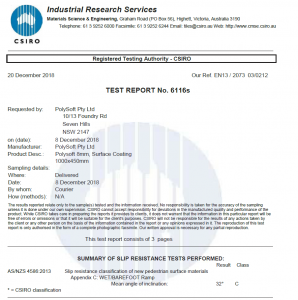
 

CSIRO test report certifying PolySoft slip resistance of 32 degrees, Class C under AS/NZS 4586 wet barefoot ramp test
Independent CSIRO testing: PolySoft achieved a 32° mean inclination angle — Class C, the highest wet barefoot slip classification.
AS 4586 Appendix C wet barefoot ramp slip rating table showing A, B and C classifications by mean angle
Classification thresholds: A ≥12°, B ≥18°, C ≥24°. PolySoft’s 32° result clears the top classification with margin.
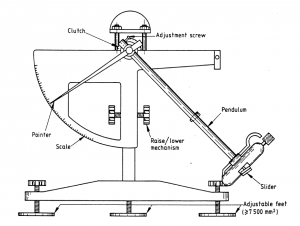
Technical drawing of a British pendulum friction tester with labelled clutch, scale, pendulum, slider and adjustable feet
Pendulum friction tester — technical drawing
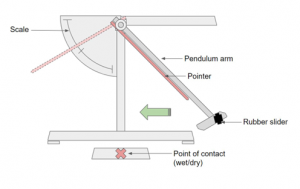
Labelled diagram of a pendulum slip resistance tester showing scale, pendulum arm, rubber slider and point of contact
The pendulum arm swings a rubber slider across the surface, mimicking a slipping heel strike; the pointer records the friction reading.

Lorem ipsum dolor sit amet consectetur adipiscing elit. Quisque faucibus ex sapien vitae pellentesque sem placerat. In id cursus mi pretium tellus duis convallis. Tempus leo eu aenean sed diam urna tempor. Pulvinar vivamus fringilla lacus nec metus bibendum egestas. Iaculis massa nisl malesuada lacinia integer nunc posuere. Ut hendrerit semper vel class aptent taciti sociosqu. Ad litora torquent per conubia nostra inceptos himenaeos.

Lorem ipsum dolor sit amet consectetur adipiscing elit. Quisque faucibus ex sapien vitae pellentesque sem placerat. In id cursus mi pretium tellus duis convallis. Tempus leo eu aenean sed diam urna tempor. Pulvinar vivamus fringilla lacus nec metus bibendum egestas. Iaculis massa nisl malesuada lacinia integer nunc posuere. Ut hendrerit semper vel class aptent taciti sociosqu. Ad litora torquent per conubia nostra inceptos himenaeos.

Lorem ipsum dolor sit amet consectetur adipiscing elit. Quisque faucibus ex sapien vitae pellentesque sem placerat. In id cursus mi pretium tellus duis convallis. Tempus leo eu aenean sed diam urna tempor. Pulvinar vivamus fringilla lacus nec metus bibendum egestas. Iaculis massa nisl malesuada lacinia integer nunc posuere. Ut hendrerit semper vel class aptent taciti sociosqu. Ad litora torquent per conubia nostra inceptos himenaeos.

Lorem ipsum dolor sit amet consectetur adipiscing elit. Quisque faucibus ex sapien vitae pellentesque sem placerat. In id cursus mi pretium tellus duis convallis. Tempus leo eu aenean sed diam urna tempor. Pulvinar vivamus fringilla lacus nec metus bibendum egestas. Iaculis massa nisl malesuada lacinia integer nunc posuere. Ut hendrerit semper vel class aptent taciti sociosqu. Ad litora torquent per conubia nostra inceptos himenaeos.

Lorem ipsum dolor sit amet consectetur adipiscing elit. Quisque faucibus ex sapien vitae pellentesque sem placerat. In id cursus mi pretium tellus duis convallis. Tempus leo eu aenean sed diam urna tempor. Pulvinar vivamus fringilla lacus nec metus bibendum egestas. Iaculis massa nisl malesuada lacinia integer nunc posuere. Ut hendrerit semper vel class aptent taciti sociosqu. Ad litora torquent per conubia nostra inceptos himenaeos.

View more Blog

Contact us

Need product advice, pricing or specifications?

Speak with a PolySoft consultant.

Play
Playground safety surfacing and 3D shapes
Aquatrak
Smooth non-porous aquatic surfacing
AquaSoft Tiles
Cushioning aquatic safety tiles
Trail
Natural-look outdoor walkway surfacing
Sport
A premium surface for sports court coating
Byron Pool Paint
Premium pool paint coating
Jewels 4 Pools
Glass pool render finish
WPC Decking
Composite decking boards

Download specification sheet